
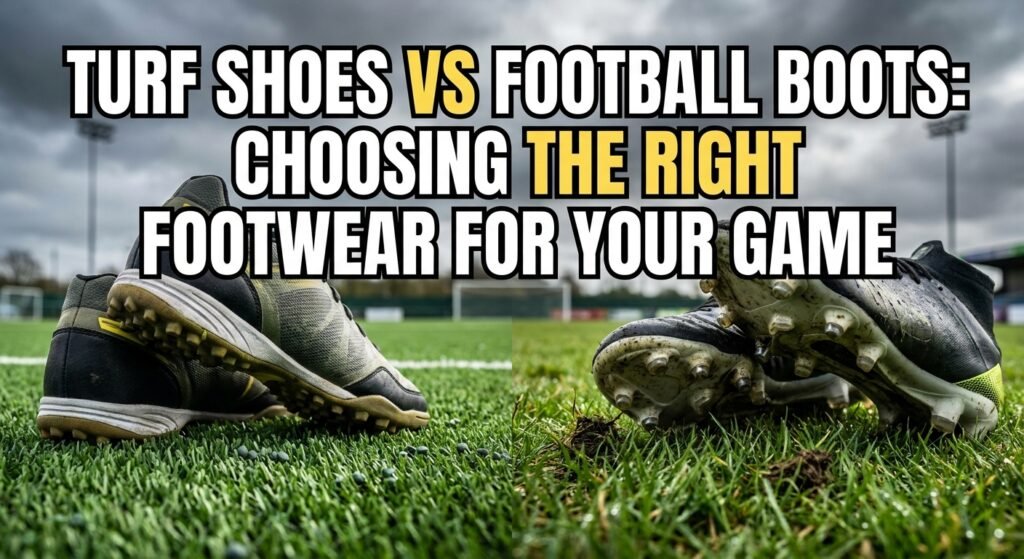

Turf Shoes vs Football Boots: Choosing the Right Footwear for Your Game
Choosing the right footwear is crucial for any footballer, not just for performance, but also for comfort and injury prevention. While turf shoes and football boots (often referred to as cleats) might look similar to the untrained eye, they are specifically engineered for different playing surfaces. Understanding these distinctions is key to elevating your game and ensuring you’re always prepared for the pitch ahead.
What Are Turf Shoes?
Turf shoes are designed for artificial grass or synthetic turf fields, as well as hard ground surfaces. They are identifiable by their unique outsoles, which feature numerous short, rubber studs or a dense pattern of small nubs.
- Surface Compatibility: Ideal for artificial turf, older or more worn artificial grass, and hard outdoor surfaces.
- Grip and Traction: The small rubber knobs create friction against the surface rather than penetrating it deeply, providing consistent, even grip and balanced traction. This allows for smooth movements, quick cuts, and transitions without getting stuck.
- Comfort and Cushioning: Turf shoes often prioritize comfort, feeling softer and more flexible, akin to sneakers. They typically offer enhanced cushioning to reduce impact on joints, which is beneficial on the harder artificial surfaces.
- Durability: Built to withstand the abrasive nature of artificial grass, turf shoes often feature reinforced toe areas and vulcanised rubber outsoles, contributing to their longevity.
- Injury Prevention: The design of turf shoe outsoles acts as a mechanical safety valve, allowing for slight release when rotational forces are too high, which can help prevent injuries on artificial surfaces.
What Are Football Boots (Cleats)?
Football boots, or cleats, are engineered for natural grass pitches and come in various stud configurations tailored to different grass conditions (firm ground, soft ground, artificial ground). Their defining characteristic is the longer, more aggressive studs designed to penetrate the ground.
- Surface Compatibility: Primarily designed for natural grass fields, including firm ground (FG), soft ground (SG), and modern artificial ground (AG) pitches.
- Grip and Traction: The longer studs dig into the natural grass, providing aggressive grip and strong push-off for explosive acceleration, sharp turns, and quick changes in direction. AG boots, specifically, offer good traction on modern 3G and 4G artificial pitches.
- Comfort and Structure: Cleats typically offer a tighter, more structured feel, which supports performance, especially during aggressive movements. While modern cleats offer good comfort, they are generally less cushioned than turf shoes.
- Durability: While AG boots are more durable on artificial grass than FG boots, turf shoes generally have an edge in durability on synthetic surfaces due to their rubber outsoles.
- Injury Risk: Using standard cleats (especially FG) on artificial turf can increase stud pressure and the risk of catching the surface, potentially leading to strain or imbalance.
Key Differences at a Glance
| Feature | Turf Shoes | Football Boots (Cleats) |
|---|---|---|
| Primary Surface | Artificial turf, hard ground | Natural grass, modern artificial ground |
| Sole Design | Short rubber studs/nubs | Longer molded or removable studs |
| Traction | Even, balanced grip; friction-based | Deep, aggressive penetration; strong push-off |
| Comfort | High, sneaker-like, more cushioning | Firm, structured, performance-focused |
| Durability | Excellent on abrasive turf | Varies by type; AG boots good on artificial grass |
| Movement | Smooth, flexible, quick cuts | Explosive, strong push-off, sharp turns |
| Injury Risk | Lower on hard turf | Higher on wrong surface (e.g., FG on turf) |
Making the Right Choice for Your Game
The decision between turf shoes and football boots ultimately boils down to where you play most frequently.
- If the majority of your games and training sessions are on artificial turf fields, especially older or flatter surfaces, turf shoes are your best bet. They offer superior comfort, durability, and a reduced risk of injury on these surfaces.
- If you primarily play on natural grass fields or modern 3G/4G artificial pitches, football boots designed for those specific surfaces (e.g., FG for firm ground, AG for artificial ground) will provide the necessary traction, responsiveness, and control for optimal performance.
For avid players who switch between various surfaces, investing in both a quality pair of turf shoes and appropriate football boots will ensure you’re always equipped for any pitch, maximizing your performance and protecting your feet. Don’t let improper footwear hold you back; choose wisely and dominate the game!